Learn about what are the different types of google ads.Identify the various kinds of Google Ads; such as Search, Display, Video, Shopping, and App campaigns, which can be used to increase traffic, leads, sales, and brand awareness.
Introduction
Google Ads is a useful adverse platform capable of assisting organizations to contact the prospective clients within Google search, You Tube, Display Network, Gmail and Maps. Advertisers have the opportunity to target the campaigns to meet specific goals as there are numerous ad formats, including Search, Display, Video, Shopping, App Campaigns, and Performance Max.
Knowledge of the various kinds of Google Ads is crucial in the process of generating traffic to the site, leads, sales, and brand awareness, and this way of advertising makes sure that the business gets the most out of the advertisements.
What Is Google Ads?
Google Ads is the online advertisement system of Google through which business people can post adverts in its search, YouTube, Gmail, Maps, and partner websites. The pay-per-click (PPC) structure enables the targeting and enables the measurement of its results and adjust the budgets, which contributes to companies gaining the interest of the potential customers and increase their presence in the online environment successfully.

How Google Ads Works?
Google Ads is an auction platform that allows a company to purchase keywords or placements. Adverts will be displayed depending on relevancy, bid price, and quality rating. Users get advertisements that are relevant to their search query or interests, and advertisers are visible, get traffic, and obtain leads. This system will guarantee effective expenditure and increased conversion probabilities.
What Are the Different Types of Google Ads?
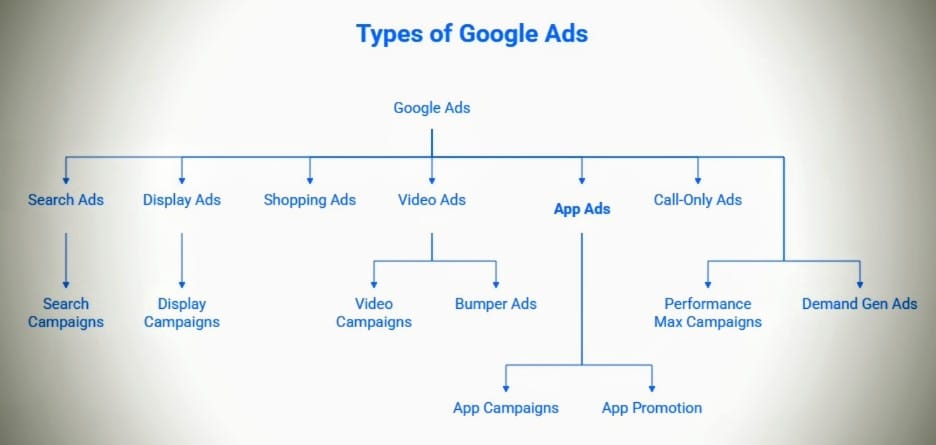
Google Ads provides customers with a broad range of advertisement variants, as well as types and forms of campaigns that allow companies to locate customers in Google Search, YouTube, websites, applications, and Maps.Both types have their purposes and advantages. A full-scale division of the most significant types of Google Ads is given below:
Search Ads
Advertisement in the form of text on Google search with suitable keywords. They attract high-intent customers who are actively interested in a product or service, which leads to clicks, leads, and conversions of users who are willing to take any action.
Search Campaigns
Full campaigns that are based on text advertisements and use keywords. They emphasize the traffic of websites and their generation of leads and sales, management of ad performance through bidding tactics, ad groups, as well as continuous monitoring to reach the relevant searchers.
Display Ads
Display advertisements (banners or visual images) that will appear on web pages, applications, and YouTube through the Google display network. They boost brand recognition, re-advertise past users, and address wide audiences beyond search engines.
Display Campaigns
Educations that format display adverts, audience targeting, placements, and budgets. They enable companies to increase visibility, create brand awareness, and improve the performance of several websites and partner platforms.
Shopping Ads
Advertisements that feature product images, titles, pricing, and the retailer on the Google Shopping page or a search result page. They are perfect in e-commerce, as they draw away buyers who are enthusiastic in their pursuit of goods, increasing the clicks and purchases.
Video Ads
Advertisements on YouTube and Google partner websites, in which brands can tell stories, promotions, and product demonstrations using an interesting visual message to engage attention and lead to engagement.
Video Campaigns
Video advertisements like skippable, non-skippable, bumper, and in-feed ad campaigns. The targeting will be to reach as many people as possible and engage them with the aim of making conversions that are effective, and reach out to as many people who watch YouTube.
Bumper Ads
YouTube Non-skippable video ads (six seconds long). Good at rapid, catchy branding, expanding the reach, and making a strong impression on the viewers within a limited time.
App Ads / App Campaigns
Mobile application advertising on Search, YouTube, Google Play, and Display. Google manages the placements and targeting automatically to maximize the number of apps installed and in-app activities.
App Promotion
Targets the particular app downloads, registrations, purchases, and engagement. Automatically targets and bids to make sure that ads appear to users most likely to install or engage with the app.
Call-Only Ads
The mobile advertisements where the ads are created in such a way that they create direct phone calls and not a visit to a website. Good in service companies, they promote real-time communication and the generation of leads with easy, actionable calls-to-action.
Performance Max Campaigns
Campaigns built on artificial intelligence and that have to feature advertisements on Google Search, Display, YouTube, Shopping, Discover, Gmail, and Maps.The maximization of conversions is achieved through optimizing the targeting, bid, and ad placements automatically.
Performance Max
Means the real advertisements presented by the Performance Max campaigns with the help of automation and AI to provide the appropriate audience with the best possible ad format in terms of conversion.
Demand Gen (Demand Generation Ads)
On YouTube, Discover, and Gmail, there are visually stimulating advertisements. They are user-focused, hence they are ideal in promoting brand demand, product discovery, and engagement.
Why Google Ads Is Important for Businesses
Google Ads enables companies to connect with their targeted clients at the point at which they need a product or a service. Google Ads offers instant visibility, unlike organic marketing, which results in growth over time.
Whether it is a startup business or a worldwide brand, it can be helpful since it allows businesses to reach their target audiences according to keywords, demographics, interests, and behavior. Google Ads has other advantages, such as:
- Measurable outputs: Track clicks, impressions, conversions, and ROI.
- Flexible budgeting: It has any budget, but increases in size as performance increases.
- Multi-channel coverage: The advertisements will appear on Search, YouTube, Gmail, Maps and Display networks.
- Niche advertising: Discover high-intend willing-to-act audiences.
How Google Ads Works?
Google Ads is a pay-per- click (PPC) site where advertisers compete by bidding on keywords to showcase their adverts to the right audience. The search and browsing process whenever one is searching or browsing entails an auction where Google knows what ads to be shown based on the bid price, quality of the ad, and relevancy. Quality advertisements are placed in a better position at cheaper rates to reach and convert the target audience.
Why Google Ads Is Essential for Modern Businesses
Google Ads is a key tool that every business would require in the digital age to grow and gain prominence. It enables businesses to get potential consumers when they are actively seeking products or services, which will ensure high-intent traffic. With the assistance of sophisticated targeting possibilities, adaptable budgets, and quantified results, businesses of any scale may become the leaders, the sales, and make brand awareness.
Google Ads encourages several formats, including Search, Display, Video, Shopping, and App Campaigns, which lead to allowing brands to reach their audience in different ways. The competitive advantage of its businesses in an ever-increasing number of players online makes the capabilities of the businesses to optimize campaigns, maximize their ROI, and stay competitive because of their automation and analytics capabilities.
Why Understanding Google Ad Types Matters
Understanding the various types of Google Ads assists companies in aligning their marketing objectives to the appropriate format. The types of ads have their own purposes that include sales, leads, brand recognition, and apps. Knowledge about ad types facilitates the effective utilization of the budget, targeting, greater engagement, and performance of the campaigns in both Google search and display, YouTube, and other platforms.
How to Choose the Right Google Ad Format
The choice of Google Ad form is very important in the success of the campaign. The choice of the inadequate type can be a waste of funds, reduce the engagement, and lower the conversion rates, and one needs to know all the formats.
Step 1: Set Your Marketing Objective
The success with the campaign depends on the type of Google Ad type chosen. Every format should have a meaning because choosing the incorrect format may turn out to be a waste of money, lack of interest, and reduced conversion rate.
Step 2: Learn Your Target Audience
A campaign purpose, namely the creation of leads, sales, brand recognition, or app downloads, will dictate the most favourable format of Google Ads.
Step 3: Become Google Ad-savvy
Research Google Ad forms such as Search, Display, Video, Shopping, App Campaigns and Performance Max and monitor the performances of the various forms to determine the form that can fit the campaign objectives.
Step 4: Think of Your Budget and Get ready Creatives
Based on your advertising budget, prepare suitable ad creatives in each format, e.g. text, image, video or product feed etc. to make the best out of it and reach.
Step 5: Analyze, Test and Optimize Campaigns
Optimize the targeting, creative resources and bidding algorithms, increase the overall performance and results of the campaign and initial campaigns, measure such parameters as CTR, conversion and ROI, and improve them.

How Google Display Campaigns Increase Visibility
Google Display Campaigns is an effective method of raising brand awareness on the internet. Placing image and banner advertisements on millions of websites, applications, and Google partner platforms will enable companies to reach more people than they would through search results.
Display campaigns provide the ability to target exactly, through either demographics, interests, online actions, or a retargeting of recent visitors, meaning that the ads will reach those customers most likely to take an interest.
This will keep your brand in their minds, bring awareness and convince a potential customer to sample products or services. Along with strong messages and good images, display campaigns not only help in creating awareness but also meet other marketing goals, in that of creating leads, conversions and long term retention.
FAQ
Can I create a Google Ads account?
Yes, you can create an account and register an account at ads.google.com, where you would be required to fill your business details, select your billing, and the objective of campaign.
Can I use Display Ads to build awareness?
Yes, Display Ads are applicable in order to reach a wider audience with the help of banners or visuals on different websites, apps, and partner platforms to increase visibility.
Is Google Ads expensive?
Google Ads is charged based on rivalry in the market, requirement of the keywords, and the type of the campaign. There are also business budgets and bidding strategies managed every day, therefore, this enables businesses to scale small and big advertisers.
Do small businesses benefit from Google Ads?
In fact, targeted advertising, pay-as-you-go marketing, and flexibility of the budget can help small businesses reach certain audiences effectively. Google Ads help to generate leads, visit websites as well as market products with less budget.
How often should I optimize campaigns?
The optimization of campaigns is to be done regularly, either weekly or monthly. Tracking of such metrics as CTR, conversions, and ROAS should be used to optimize the targeting, creatives, bids, and strategy at large to achieve more efficient performance.
Can I pause or stop Google Ads anytime?
Yes, Google Ads campaigns may be stopped or discontinued at any time. Advertisers are able to store historical information and are able to restart with the campaigns when they require, without losing any history in terms of progress and performance.
Conclusion
To sum up, it is important to know the various forms of Google Ads in order to be successful in business online. All the formats, Search, Display, Video, Shopping, App Campaigns, and Performance Max, are advantaged differently to target specific marketing objectives.
With the appropriate type of ads and campaigns tailored to the requirements of the audience, budget, and goals, the businesses are able to reach their maximum, enhance the number of conversions, and get a higher ROI on Google sites.
One Response